
If you’re running a business and working with a digital marketing agency, one of the first questions you should ask is: “How do we know if this is actually working?”
That’s a smart question — because successful marketing is not based on guesses, likes, or random traffic spikes. It’s based on measurable results. The businesses that grow consistently are the ones tracking the right marketing metrics and making decisions based on data.
In this guide, we’ll break down the most important digital marketing KPIs (Key Performance Indicators), why they matter, and how they connect directly to business growth, leads, and revenue.
Why Tracking the Right Marketing Metrics Matters
Many businesses invest in marketing without fully understanding what they should measure. They focus on vanity metrics like impressions, followers, or random website visits instead of the numbers that actually affect sales.
A professional digital marketing agency should do more than just run campaigns. It should:
- Measure performance
- Identify what’s working
- Improve weak areas
- Connect marketing efforts to business goals
The real purpose of tracking metrics is simple:
Is your marketing generating growth, leads, and revenue?
If you cannot answer that clearly, your reporting system needs improvement.

Website Performance Metrics You Should Never Ignore
Your website is the center of your digital marketing strategy. Every SEO campaign, social media ad, or email marketing effort eventually leads visitors there.
If your website underperforms, your entire marketing system suffers.
Organic Traffic
Organic traffic measures how many people find your website through search engines like Google without paid advertising.
Growing organic traffic usually means:
- Your SEO strategy is improving
- Your content is ranking
- Your website visibility is increasing
A steady rise in organic traffic is one of the strongest signs of long-term digital marketing success.
Bounce Rate
Bounce rate shows the percentage of visitors who leave your website after viewing only one page.
A high bounce rate can indicate:
- Slow website speed
- Poor user experience
- Weak content relevance
- Misleading ad copy
- Poor landing page design
Improving bounce rate often leads to better conversions and stronger SEO performance.
Average Session Duration & Pages Per Session
These metrics reveal how engaged users are with your content.
If visitors stay longer and explore multiple pages, it usually means:
- Your content is valuable
- Your site structure is effective
- Users trust your brand
Engaged visitors are far more likely to become paying customers.
Core Web Vitals
Google uses Core Web Vitals as ranking factors to evaluate:
- Page loading speed
- Visual stability
- User interaction performance
A slow website can hurt both:
- Search rankings
- Conversion rates
A reliable digital marketing agency should continuously monitor and improve website speed and usability.
Lead Generation & Conversion Metrics
Traffic alone does not grow a business. Conversions do.
The following conversion metrics are critical for measuring real marketing performance.
Conversion Rate
Conversion rate measures the percentage of visitors who complete a desired action, such as:
- Filling out a form
- Booking a consultation
- Making a purchase
- Calling your business
Most business websites convert between 2% and 5%. If your conversion rate is lower, something in your funnel likely needs optimization.
Cost Per Lead (CPL)
CPL measures how much money you spend to generate one lead.
This helps businesses understand:
- Which marketing channels are efficient
- Where ad spend should increase
- Which campaigns waste money
Lower CPL with strong lead quality usually indicates healthy marketing performance.
Cost Per Acquisition (CPA)
CPA measures how much it costs to acquire an actual paying customer.
This is one of the most important KPIs for:
- E-commerce businesses
- Paid advertising campaigns
- Lead generation companies
A good marketing strategy focuses on reducing CPA while maintaining lead quality.
Return on Ad Spend (ROAS)
ROAS calculates how much revenue your advertising generates compared to ad spend.
For example:
- Spend $10,000 on ads
- Generate $50,000 in revenue
- Your ROAS = 5x
This metric clearly shows whether paid advertising is profitable.
Lead Quality Score
Not every lead is valuable.
A strong digital marketing strategy focuses on attracting:
- Qualified prospects
- Buyers with intent
- High-converting audiences
Tracking lead quality prevents businesses from wasting time on unqualified leads.
SEO Metrics That Signal Long-Term Growth
SEO is one of the highest ROI marketing channels when managed correctly.
A good digital marketing agency tracks SEO performance across multiple layers.
Keyword Rankings
Keyword rankings show where your website appears in search results for targeted search terms.
Improving rankings means:
- Better visibility
- More traffic
- Increased lead opportunities
Even moving from page two to page one can dramatically increase clicks.
Backlinks & Domain Authority
High-quality backlinks from trusted websites help improve:
- Website authority
- Search rankings
- Organic traffic growth
A strong backlink profile is essential for long-term SEO success.
Indexed Pages
Indexed pages are pages Google can actually read and display in search results.
If important pages are not indexed:
- They cannot rank
- They cannot generate traffic
- They remain invisible online
Technical SEO audits help identify indexing issues quickly.
Click-Through Rate (CTR)
CTR measures how often users click your website after seeing it in search results.
Higher CTR usually means:
- Better page titles
- Strong meta descriptions
- More compelling search listings
Improving CTR can increase traffic without improving rankings.
Social Media Metrics That Actually Matter
Many businesses focus too heavily on likes and followers.
But social media success should be measured by engagement and action.
Engagement Rate
Engagement includes:
- Comments
- Shares
- Saves
- Meaningful interactions
High engagement signals strong audience interest and brand relevance.
Link Clicks & Profile Visits
These metrics show whether social content is driving real business interest.
A good social media strategy should encourage users to:
- Visit your website
- Explore your services
- Contact your business
Paid Social Advertising Metrics
For paid social campaigns, important KPIs include:
- Cost per result
- Frequency
- Ad relevance
- Conversion rate
If audiences see the same ad too often, performance usually declines.
Email Marketing Metrics Worth Tracking
Email marketing continues to deliver one of the highest returns in digital marketing.
However, success depends on tracking the right data.
Open Rate
Open rate measures how many people open your emails.
While privacy updates have made open rates less precise, they still help evaluate:
- Subject line performance
- Audience interest
- Brand recognition
Click-to-Open Rate (CTOR)
CTOR tracks how many users clicked after opening your email.
This metric reveals whether:
- Your content is valuable
- Your offer is compelling
- Your email design is effective
Unsubscribe Rate
High unsubscribe rates often indicate:
- Over-emailing
- Poor audience targeting
- Weak content relevance
Maintaining a healthy email list improves long-term performance.
How Do You Know If Your Digital Marketing Agency Is Doing a Good Job?
A reliable digital marketing agency should provide:
- Clear reporting
- Transparent communication
- Measurable results
You should always understand:
- What work is being done
- Why it matters
- How it impacts business growth
Strong reporting sounds like this:
- “Organic traffic increased 18% this month.”
- “Your Google Ads campaign generated 47 qualified leads.”
- “Your cost per acquisition dropped by 22%.”
Weak reporting sounds like this:
- “We posted content.”
- “Your impressions increased.”
- “We boosted engagement.”
The difference is business impact.
What Reporting Schedule Should You Expect?
An effective reporting structure usually follows this timeline:
Weekly Reporting
Focus on:
- Ad spend
- Paid campaign performance
- Leads generated
- Quick optimizations
Monthly Reporting
Focus on:
- SEO growth
- Website performance
- Conversion tracking
- Content performance
- Marketing strategy adjustments
Quarterly Reviews
Focus on:
- Long-term growth
- ROI analysis
- Strategic planning
- Budget allocation
- Business goals
A professional digital marketing agency should proactively explain trends and identify issues before they become expensive problems.
One Final Thought: More Data Is Not Always Better
Tracking too many numbers creates confusion.
The best marketing teams focus on the metrics that directly affect:
- Revenue
- Leads
- Customer acquisition
- Business growth
Instead of overwhelming reports, businesses need clear dashboards with actionable insights.
When reporting becomes simple and transparent, decision-making becomes easier.
Conclusion
Successful digital marketing is not about chasing vanity metrics or generating random traffic. It’s about tracking meaningful data that drives real business growth.
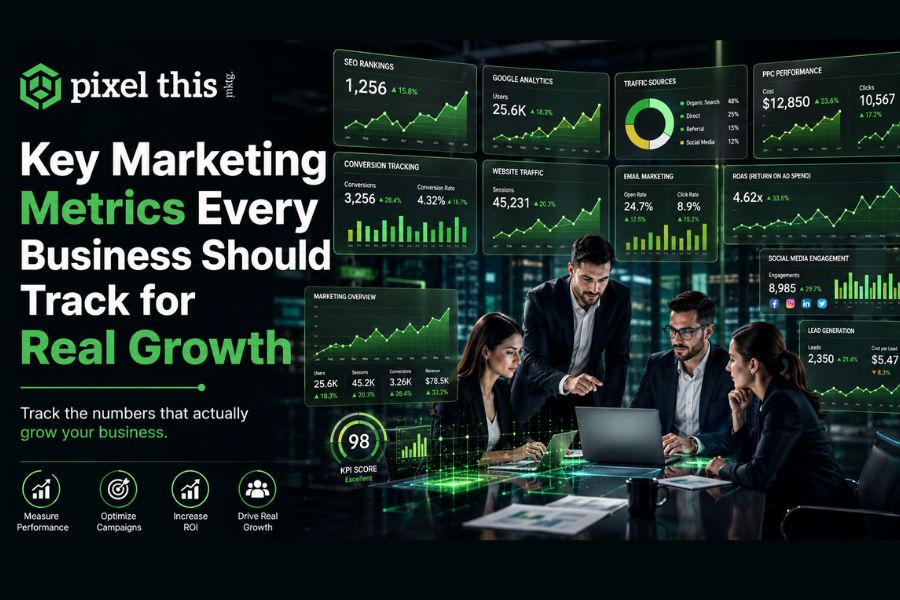
From SEO and website analytics to paid advertising and email marketing, every channel should connect back to measurable results like leads, conversions, and revenue.
At Pixel This Marketing, we help businesses build marketing systems focused on performance, transparency, and long-term growth. Our team believes in honest reporting, clear communication, and strategies backed by real data — not guesswork.
If you’re unsure whether your current marketing efforts are delivering results, we’d be happy to help you evaluate your strategy and reporting setup.
Ready to understand what your marketing is really doing for your business?
Get in touch with us today to schedule a strategy session and discover how data-driven marketing can help your business grow smarter and faster.
Frequently Asked Questions (FAQs)
Q: What are the most important digital marketing metrics to track?
The most important metrics include:
- Conversion Rate
- Cost Per Lead (CPL)
- Return on Ad Spend (ROAS)
- Organic Traffic
- Bounce Rate
- Customer Acquisition Cost (CPA)
These KPIs help businesses measure actual growth and marketing performance.
Q: How often should a digital marketing agency provide reports?
Most businesses should receive:
- Weekly updates for paid advertising campaigns
- Monthly reports for SEO and overall marketing performance
- Quarterly reviews for long-term strategy and ROI analysis
Consistent reporting helps businesses make informed decisions.
Q: Why is conversion rate more important than website traffic?
Traffic alone does not generate revenue. Conversion rate shows how effectively your website turns visitors into leads or customers. A smaller amount of highly targeted traffic often performs better than large amounts of low-quality traffic.
Q: How do I know if my SEO strategy is working?
Signs of a successful SEO strategy include:
- Increasing organic traffic
- Higher keyword rankings
- Improved click-through rates
- Better lead generation from search engines
- Growth in qualified website visitors
SEO is a long-term strategy, so consistent growth over time is the key indicator.


