
Hiring a digital marketing agency is an investment in your business growth. Whether you’re paying for SEO, Google Ads, social media marketing, email campaigns, or content marketing, one question matters more than anything else:
Where are my leads actually coming from?
Many business owners receive monthly reports filled with impressions, clicks, and website traffic numbers. While those metrics can be useful, they don’t tell the full story. The real measure of success is lead generation and revenue. If you can’t clearly identify which marketing efforts are producing qualified leads and customers, you’re making business decisions based on guesswork.
In this guide, we’ll explain how to properly track lead generation from your digital marketing agency, what tools you should be using, which metrics matter most, and how to ensure your marketing budget is delivering measurable results.
Why Lead Tracking Is Essential for Business Growth
Lead tracking allows you to connect your marketing investment directly to business outcomes. Instead of simply knowing how many people visited your website, you’ll understand:
- Which marketing channels generate the most leads
- Which campaigns produce the highest-quality prospects
- How much you’re paying for each lead
- Which leads eventually become paying customers
- Where to increase or reduce your marketing budget
Without accurate lead tracking, it’s impossible to determine your true return on investment (ROI). You may be spending thousands of dollars each month on marketing activities that aren’t generating meaningful business results.
Successful businesses don’t rely on assumptions. They rely on data.
Build the Right Tracking Foundation First
Before analyzing any lead generation data, your digital marketing agency should establish a strong tracking infrastructure.
Google Analytics 4 (GA4)
Google Analytics 4 is one of the most powerful tools available for measuring website performance and user behavior.
However, simply installing GA4 isn’t enough.
Your agency should configure conversion events such as:
- Contact form submissions
- Phone call clicks
- Appointment bookings
- Quote requests
- Newsletter signups
- Thank-you page visits
These conversion events allow you to track actual lead generation instead of just website traffic.
Google Search Console
Google Search Console helps businesses understand how people find their website through organic search.
It provides valuable information including:
- Search keywords
- Click-through rates
- Search impressions
- Ranking positions
- Landing page performance
This data helps identify which SEO efforts are generating qualified traffic and leads.
UTM Tracking Parameters
UTM parameters are tracking tags added to URLs that help identify traffic sources.
For example, when someone clicks a Facebook ad, UTM parameters tell Google Analytics exactly which campaign generated that visit.
Without UTM tracking, traffic attribution becomes unreliable, making it difficult to determine which marketing channels are delivering results.
A professional digital marketing agency should use UTM parameters for every paid and promotional campaign.

How to Track Leads From Different Marketing Channels
Each marketing channel requires a slightly different tracking approach.
Organic Search (SEO)
SEO lead tracking combines data from Google Analytics and Google Search Console.
Key metrics to monitor include:
- Organic website traffic
- Top-performing landing pages
- Keyword rankings
- Organic conversion rates
- Organic leads generated
Ask your agency to show exactly how many leads came from organic search each month rather than simply reporting keyword rankings.
Google Ads
Google Ads offers some of the most detailed lead tracking available.
Your agency should be monitoring:
- Cost per click (CPC)
- Cost per lead (CPL)
- Conversion rate
- Conversion value
- Return on ad spend (ROAS)
Every campaign should have conversion tracking properly installed so you can see exactly how much each lead costs.
Social Media Marketing
Tracking social media leads can be more challenging because users often interact with content multiple times before converting.
To improve accuracy, agencies often use:
- Dedicated landing pages
- UTM parameters
- Lead generation forms
- CRM integrations
This makes it easier to determine which social campaigns are producing leads.
Email Marketing
Email marketing remains one of the highest-ROI marketing channels available.
Effective email tracking should include:
- Open rates
- Click-through rates
- Conversion rates
- Revenue generated
- Leads created
Every email campaign should use trackable links that connect back to your analytics and CRM systems.
The Most Important Lead Generation Metrics
Many agencies overwhelm clients with data that looks impressive but doesn’t help decision-making.
Instead, focus on these core metrics:
Total Leads Generated
The number of leads generated during a specific period.
Cost Per Lead (CPL)
This metric tells you how much you’re spending to acquire each lead.
A lower CPL generally indicates more efficient marketing performance.
Conversion Rate
The percentage of visitors who become leads.
Improving conversion rates often delivers better results than simply increasing traffic.
Lead-to-Customer Rate
Not every lead becomes a customer.
Tracking this metric helps identify which marketing channels generate the highest-quality prospects.
Customer Acquisition Cost (CAC)
CAC measures the total cost required to acquire a new customer.
This is one of the most important indicators of marketing profitability.
Return on Investment (ROI)
Ultimately, every marketing activity should contribute to business growth and revenue generation.
ROI shows whether your marketing investment is producing a positive financial return.
Why Your CRM Is Critical for Accurate Lead Tracking
Many businesses stop tracking once a lead fills out a form.
That’s a mistake.
The real goal is understanding which leads become customers.
A Customer Relationship Management (CRM) system helps bridge the gap between marketing and sales.
Popular CRM platforms include:
- HubSpot
- Zoho CRM
- Salesforce
- Pipedrive
When connected properly, a CRM can show:
- Lead source
- Sales pipeline stage
- Customer value
- Closed revenue
- Lifetime customer value
This process is often called closed-loop reporting, and it provides the clearest picture of marketing performance.
Questions Every Business Owner Should Ask Their Agency
A trustworthy digital marketing agency should be transparent about performance.
Consider asking:
Can you show me leads by marketing channel?
You should be able to see exactly how many leads came from SEO, paid ads, social media, email marketing, and direct traffic.
What is our current cost per lead?
Your agency should have this number readily available.
How are phone calls being tracked?
Many service-based businesses generate most of their leads through phone calls.
Tools like CallRail allow agencies to track phone calls back to specific campaigns.
Can I access a live reporting dashboard?
Platforms like Google Looker Studio can provide real-time access to your marketing performance.
You shouldn’t have to wait for monthly reports to understand what’s happening.
Common Lead Tracking Mistakes Businesses Make
Even businesses with experienced marketing agencies sometimes encounter tracking issues.
Common mistakes include:
No Conversion Tracking
Without conversion tracking, you only see traffic—not results.
Missing UTM Parameters
Campaign attribution becomes inaccurate when links aren’t properly tagged.
Ignoring Phone Call Leads
Phone calls are often some of the most valuable conversions for service businesses.
Tracking Quantity Instead of Quality
Not all leads are equal.
Focus on revenue and customer acquisition rather than simply counting form submissions.
Failing to Connect Marketing and Sales Data
Marketing and sales teams should work together to track the entire customer journey.
Creating a Simple Lead Tracking Dashboard
You don’t need dozens of reports to understand marketing performance.
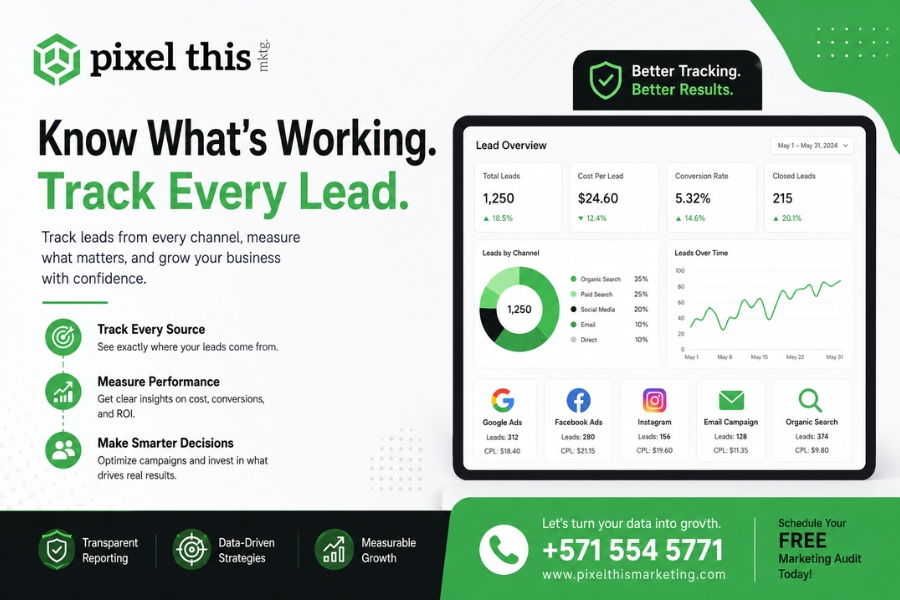
A simple dashboard should include:
- Total leads
- Leads by source
- Cost per lead
- Conversion rates
- Top-performing landing pages
- Revenue generated
Google Looker Studio can connect directly with Google Analytics, Google Ads, Search Console, and CRM systems to create a centralized reporting dashboard.
This allows you to monitor performance anytime without waiting for monthly updates.
Conclusion: Better Tracking Creates Better Marketing
Lead tracking isn’t about questioning your digital marketing agency—it’s about creating accountability and making smarter business decisions.
When you know exactly where your leads come from, how much they cost, and which channels generate revenue, you can confidently invest in the strategies that work best.
The most successful businesses aren’t necessarily spending more on marketing. They’re measuring performance more effectively.
At Pixel This Marketing, we believe every client deserves complete transparency. We focus on measurable growth, accurate reporting, and marketing strategies that generate real business results—not just clicks and impressions.
Ready to Discover Where Your Leads Are Coming From?
If you’re unsure whether your current marketing campaigns are being tracked correctly, we’re here to help.
Contact Pixel This Marketing today for a free marketing audit and lead tracking review.
📞 Call Us: +1 (571) 554-5771
🌐 Website: https://pixelthismarketing.com/
Our team will help you uncover tracking gaps, improve campaign visibility, and build a marketing strategy that delivers measurable ROI.
Frequently Asked Questions
Q. What is lead tracking in digital marketing?
Lead tracking is the process of identifying where potential customers come from and monitoring their journey from initial contact through becoming a paying customer.
Q. Which tools are best for tracking marketing leads?
Popular tools include Google Analytics 4, Google Search Console, HubSpot CRM, Zoho CRM, CallRail, Google Ads Conversion Tracking, and Google Looker Studio.
Q. How can I tell if my digital marketing agency is generating quality leads?
Look beyond lead volume and evaluate lead-to-customer conversion rates, customer acquisition costs, and revenue generated from each marketing channel.
Q. Why is cost per lead important?
Cost per lead helps determine how efficiently your marketing budget is being used. It allows you to compare different marketing channels and optimize spending for better results.


