

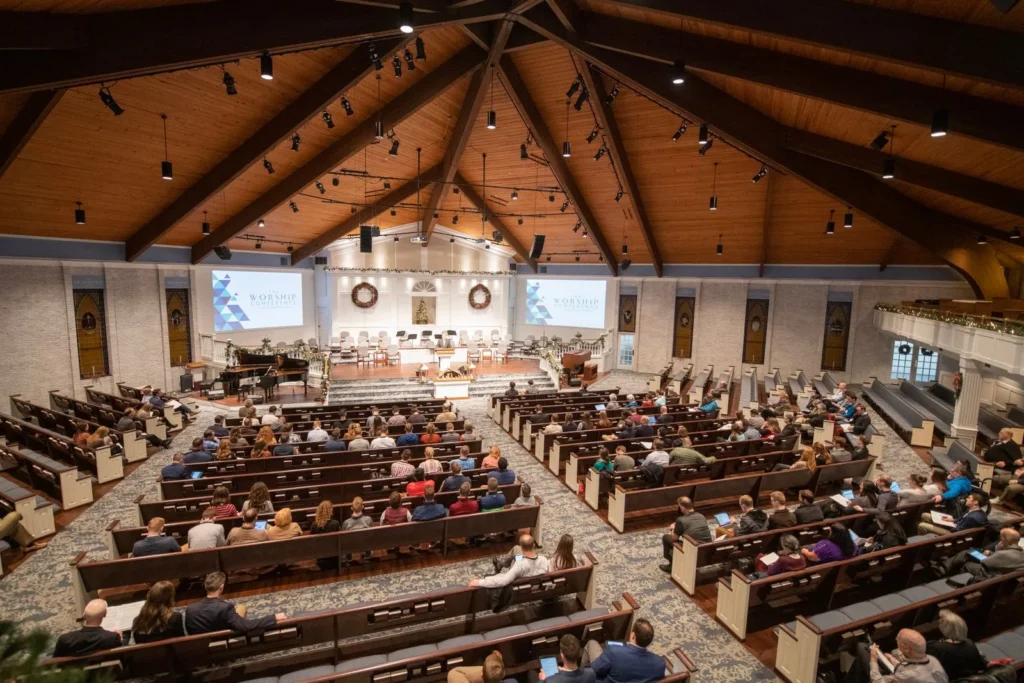
Church marketing in the DMV comes down to one job: helping a neighbor who has never walked through your doors feel confident enough to visit once, then making that first visit easy. Churches, mosques, synagogues and other faith communities across Fairfax, Loudoun, Prince William, Montgomery and Prince George’s counties and the District compete for attention with busy commutes, youth sports and dozens of other congregations within a short drive.
This guide gives faith leaders and communications teams 10 practical church marketing ideas that fit the rules that actually apply to religious organizations: how Google treats ads for places of worship, what Google Ad Grants requires, how Virginia and Maryland handle fundraising registration for religious groups, and what to check before you livestream worship music. Each idea includes what to do, why it works and how to measure it.
Why church marketing in the DMV is different
Google treats places of worship as a sensitive ad category. Google’s policy on religious beliefs in personalized advertising lists places of worship, religious guidance, religious education and religious products or topics as examples of a sensitive interest category. For these ads you can use Google’s predefined audiences, but you can’t use advertiser-curated audiences such as uploaded Customer Match lists or your own data segments. Many standard “retarget your website visitors” playbooks simply don’t apply to a congregation’s ads.
Your tax status shapes which free tools you can use. The IRS says churches that meet the section 501(c)(3) requirements are automatically considered tax exempt and don’t have to apply for recognition. But Google’s U.S. eligibility rules for Google for Nonprofits (the doorway to Ad Grants) require organizations to be registered with the IRS as 501(c)(3) exempt, or to be part of a group exemption with proven affiliation to a central nonprofit, and every organization must be verified by Google’s partner Goodstack.
Virginia and Maryland treat religious fundraising differently. Virginia’s charitable solicitation law defines “charitable organization” so that it does not include a church or convention or association of churches primarily operated for nonsecular purposes (Va. Code § 57-48). Maryland’s law exempts a religious organization from charity registration if it doesn’t employ a professional solicitor and has in effect a declaration of tax-exempt status from the federal government (Md. Business Regulation § 6-102). That last condition matters if your congregation has never requested an IRS determination letter.
1. Build a “Plan Your Visit” page that answers every nervous question
The most important page on a church website isn’t the sermon archive. It’s the page a first-time guest reads on Saturday night. Cover service times, how long a service lasts, where to park, which entrance to use, what people wear, what happens with kids, whether there’s a nursery, accessibility (elevators, hearing loops, wheelchair seating) and which languages services are offered in.
- Add a short form (“Let us know you’re coming”) so a greeter can meet the family at the door.
- Use real photos of your building, entrance and kids’ area rather than stock images, so guests recognize the place.
- Measure it: track form submissions and clicks on the map or directions link as your main conversion. If your website can’t record those events, fix that first.
2. Make your Google Business Profile do the welcoming
When someone searches “church near me” or “mosque in Herndon,” your Google Business Profile is often the first thing they see. Keep service times accurate, add photos of the entrance and parking lot, post upcoming events and holiday services, and reply to reviews in a warm, non-defensive way. For the step-by-step setup, use our Google Business Profile optimization guide.
Holiday schedules are where profiles most often go wrong. Christmas Eve 2026 falls on a Thursday and Christmas Day on a Friday, so many congregations will run extra weekday services. Update the profile and website at least two weeks ahead, and check that the times match everywhere.
Measure it: in your Business Profile performance view, watch searches, direction requests and website clicks month over month, and compare holiday weeks to normal weeks.
3. Apply for Google Ad Grants the right way
Ad Grants gives eligible charities free Google Search ads, and it can be the single biggest marketing resource a congregation has. Before applying, confirm three things from Google’s own pages:
- Tax status on record: Google’s U.S. rule requires IRS registration as a 501(c)(3) or proven affiliation under a group exemption. If your church never applied for a determination letter, ask your denomination whether its group ruling covers you (the IRS explains group rulings in Publication 4573).
- Charitable purpose: the Ad Grants terms say grantees must be organized and operated exclusively for charitable purposes.
- No election ads: the same terms say Ad Grants accounts aren’t eligible to run election ads where verification is required.
Once approved, the account has its own performance rules (click-through rate, conversion tracking and more). We covered those in detail in our nonprofit marketing guide, so use that checklist rather than learning them by suspension.
Measure it: conversions from Ad Grants (visit-plan forms, event sign-ups, prayer request forms) per month, not clicks.
4. Run paid ads that respect the sensitive-category rules
Ad Grants covers Search ads only. If you also run paid campaigns (for a building opening, a holiday service or a community event), plan around Google’s restrictions instead of fighting them.
| Targeting option | Allowed for place-of-worship ads? | What to do instead |
|---|---|---|
| Keywords people search (e.g., “Christmas Eve service Reston”) | Yes | Build one ad group per service or event, each pointing to its own landing page. |
| Location targeting around your building | Yes (location isn’t an audience list; the policy only limits ZIP targeting for housing, jobs and credit ads) | Keep the radius to a realistic drive for a weekly service. |
| Google’s predefined audiences (affinity, in-market, life events) | Yes, per the policy | Test “moving to a new home” style life events for newcomers to your area. |
| Customer Match (uploading your member email list) | No | Email members directly instead of advertising to them. |
| Your data segments (website visitor remarketing) | No | Use email or text follow-up for people who filled out a form (with their consent). |
If you’re used to remarketing for a business, note that our retargeting guide applies to standard advertisers; for ads about a place of worship, the policy above wins. Our Google Ads management team can set up campaigns that stay inside these lines.
5. Publish a seasonal calendar people actually search for
Search interest for faith communities clusters around holidays and life moments. Plan content and ads around those weeks rather than spreading effort evenly.
| Season | What people search for | Content to publish | Publish by |
|---|---|---|---|
| Christmas (Thu Dec 24 – Fri Dec 25, 2026) | Christmas Eve services, candlelight services, kids’ programs | One page per service with times, length, parking and childcare | Early December |
| New Year | Watch night services, small groups, classes | “Start the year” class and group sign-up page | Mid-December |
| Ramadan (projected to begin around Feb 8, 2027) | Iftar near me, taraweeh prayer times, community iftars | Nightly schedule, iftar sign-ups, parking plan, volunteer page | Mid-January |
| Back to school (late summer) | Youth groups, children’s ministry, weekend schools | Program pages with ages, times and safety policies | July |
Ramadan dates depend on moon sighting; the projection above comes from published astronomical calculations, and your community’s announced dates may differ by a day. Easter and Passover dates for 2027 should come from your own tradition’s calendar.
6. Livestream and post sermons, but check music licensing first
Online services let people “try you out” before they visit, and a well-organized sermon library on YouTube and your website gives search engines real content to index. Title each video with the topic people would search (“What the Bible says about anxiety,” “Understanding Surah Al-Kahf”) rather than “Sunday 11am.”
Before you stream worship music, read the copyright law closely. The federal exemption in 17 U.S.C. § 110(3) covers performance of religious musical works “in the course of services at a place of worship or other religious assembly.” It doesn’t mention transmissions, and the next exemption in the same section, § 110(4), expressly excludes “a transmission to the public.” In plain terms: singing in the room is covered; putting the song online may need a separate streaming license. Talk to your licensing provider or attorney before you go live.
Measure it: track live viewers, average watch time, and how many “Plan Your Visit” forms mention watching online first.
7. Serve the languages your neighborhood speaks
The DMV has congregations worshipping in Spanish, Korean, Amharic, Arabic, Urdu, Tagalog and many other languages. If you hold services in more than one language, give each language its own page (or its own section of the site) rather than relying on a translate button. We go deeper on multilingual pages and Google’s guidance for them in our halal restaurant marketing guide, and the same rules apply to a church site.
Measure it: visits to each language page and form submissions by language.
8. Turn community programs into front doors
Food pantries, ESL classes, tutoring, citizenship classes, grief groups, blood drives and parents’ nights out often reach more neighbors than worship services. Give each program its own page with dates, location, who it’s for and how to sign up, and promote it on your Business Profile and social media.
- Partner with nearby schools, apartment managers and community centers to share flyers and links.
- If you run a preschool or day school, see our guides for daycares and private schools; the private school guide also explains the new federal scholarship tax credit that may matter to donors who support religious schools.
Measure it: program sign-ups, and how many program participants later attend a service or event.
9. Make giving simple and well documented
An online giving page should load fast, work on a phone, offer recurring gifts and explain where the money goes (missions, benevolence, building fund). Keep giving records clean: the IRS receipt rules for gifts of $250 or more and quid pro quo contributions apply to churches too, and we summarized them in our nonprofit guide.
On fundraising registration, check where you solicit. Virginia’s definition of “charitable organization” leaves out churches operated primarily for nonsecular purposes, while Maryland’s religious exemption requires a federal tax-exempt declaration and no professional solicitor. If you run a separate ministry, school or community nonprofit, it may not fit the church exception, so confirm its status before a public campaign.
10. Follow up with first-time guests within a week
A common gap is follow-up: guests visit once and never hear from anyone. Set up a simple welcome sequence: a thank-you message the same day, an invitation to a newcomers’ lunch or class in the first week, and a note about small groups or volunteering in the first month. Ask for permission to email or text on the connect card, and make unsubscribing easy. Our email marketing team builds these sequences for organizations of every size.
Measure it: the share of first-time guests who return within 30 days and within 90 days.
How to budget and measure church marketing
Start with the outcome you care about (returning guests, program sign-ups, volunteers) and work backward. A simple method:
- Count first-time guests per month for the last three months, using connect cards or check-in data.
- Ask every new guest “How did you hear about us?” with fixed choices: friend, Google search, Google Maps, social media, event, drove by, online service.
- Track website conversions: plan-a-visit forms, event sign-ups, directions clicks.
- Compare cost per first-time guest by channel once a quarter.
Worked example (illustrative numbers only): a congregation spends $300 a month on paid social for a holiday series and gets 15 plan-a-visit forms; 9 of those families attend. That’s about $33 per visiting family. If Ad Grants brings 12 visiting families at no media cost but needs four hours of staff time a month to manage, compare that time cost honestly before deciding where volunteers should focus.
Get help from a Northern Virginia team that knows nonprofits
Pixel This Marketing is a Northern Virginia digital marketing agency with offices in Sterling and Ashburn. We help faith communities and nonprofits across DC, Maryland and Virginia with websites, local SEO, Google Ads and Ad Grants, and social media, built around the rules that apply to religious organizations.
Get a custom marketing proposal for your congregation, or book a call to talk through your next season.
Frequently Asked Questions
Can a church use Google Ad Grants?
Yes, if it meets Google for Nonprofits’ U.S. rules: it must be registered with the IRS as a 501(c)(3) exempt organization or be part of a group exemption with proven affiliation, be verified by Goodstack, and be operated exclusively for charitable purposes. Churches that never requested IRS recognition may need to confirm group-exemption coverage first.
Can churches use remarketing or Customer Match in Google Ads?
Google lists places of worship as a sensitive interest category under its religious beliefs policy. Advertisers can use Google’s predefined audiences but can’t use advertiser-curated audiences, which include Customer Match and your own data segments such as website visitor lists.
Does a church in Virginia have to register before asking for donations?
Virginia’s charitable solicitation law defines “charitable organization” so that it excludes a church or convention or association of churches primarily operated for nonsecular purposes. Separate ministries or nonprofits connected to a church should check their own status with the Virginia Department of Agriculture and Consumer Services.
Do churches need a license to livestream worship songs?
The federal exemption in 17 U.S.C. § 110(3) covers performing religious music in the course of services at a place of worship. It doesn’t mention online transmissions, so confirm whether you need a separate streaming license. Check with your licensing provider or attorney before you stream.
What is the best way to get more first-time visitors to church?
Make the first visit easy to picture and plan: a clear Plan Your Visit page, an accurate Google Business Profile with service times and photos, search ads for holiday services, and a personal follow-up within a week. Then ask every guest how they heard about you so you can invest in what works.
Last updated November 24, 2026