



The insurance agency marketing ideas that work best in the DMV start with the calendar. A family in Loudoun, a couple in Silver Spring and a retiree in Arlington can be shopping under three different deadlines in the same month, and an agency that markets to the right deadline in the right place wins the appointment before the big carriers’ ads do.
This guide gives independent agents and agencies in Northern Virginia, DC and suburban Maryland ten practical ideas: an enrollment-season plan, compliant ad copy, Medicare marketing rules, owned lead generation, reviews, search, email and referral partners. Every rule mentioned links to the official source, so you can check it before you publish anything.
Why insurance agency marketing in the DMV is different
Three health marketplaces, three calendars. Virginia runs its own marketplace: Virginia’s Insurance Marketplace open enrollment runs from November 1, 2026 through January 29, 2027. Maryland Health Connection lists Maryland open enrollment as November 1 to January 15. On HealthCare.gov, open enrollment runs November 1 to January 15, with December 15 as the last day to enroll for coverage that starts January 1. An ad that says “enroll by January 15” is wrong for a Virginia client and right for a Maryland one.
Medicare has its own season. Medicare.gov lists the Open Enrollment Period as October 15 to December 7, and the Medicare Advantage Open Enrollment Period (only for people already in a Medicare Advantage Plan) as January 1 to March 31.
Virginia regulates insurance advertising closely. Va. Code § 38.2-503 bans any advertisement or statement about the business of insurance that is untrue, deceptive or misleading, in any medium. For accident and sickness insurance, the Bureau of Insurance’s 14VAC5-90 adds detailed rules on testimonials, insurer identity, special offers and more.
No Local Services Ads for agencies here. Google’s Local Services Ads category list shows “Insurance agency (California and Florida only),” so DMV agencies can’t use that pay-per-lead format. Search, Business Profile and regular Google Ads carry the load instead.
1. Build an enrollment calendar by state, not one national campaign
Split your health campaigns by where the client lives. The table below uses the dates published on each official site this season; confirm them again before you launch, and for DC clients check the dates on the marketplace DC residents use before you advertise any deadline.
| Who you are marketing to | Window | Key deadline to feature | Campaign angle |
|---|---|---|---|
| Virginia individuals and families | Nov 1, 2026 – Jan 29, 2027 | January 29, 2027 (end of open enrollment) | “Review your plan with a local agent before January 29” |
| Maryland individuals and families | Nov 1 – Jan 15 | January 15 | “Compare Maryland Health Connection plans before January 15” |
| Clients in HealthCare.gov states | Nov 1 – Jan 15 | Dec 15 for Jan 1 coverage; Jan 15 final | “Enroll by December 15 for January 1 coverage” |
| People with Medicare | Oct 15 – Dec 7 | December 7 | “Review your coverage before December 7” |
| Current Medicare Advantage members | Jan 1 – Mar 31 | March 31 | “Second-look review” for clients unhappy with their plan |
Measure it: appointments booked per state and per window. Shift budget weekly toward the state with the nearest deadline.
2. Give every line of business its own page
Auto, home, renters, life, health, Medicare and small-business coverage are different searches with different worries. Build a page for each line you actually write, with the carriers you represent, what information to have ready for a quote, and a clear way to book. Show your agency’s license details; under Va. Code § 38.2-1822, nobody may sell, solicit or negotiate insurance in Virginia as an agent without a license, and every individual acting for an agency must be licensed and appointed where required. Showing the license is proof, not just paperwork.
Measure it: quote requests per page. Pages that get traffic but no requests usually need a shorter form or a phone button above the fold. A well-built agency website makes these pages easy to add.
3. Write ad copy that stays inside the rules
For accident and sickness insurance, 14VAC5-90 spells out what Virginia ads can and can’t do. Use this as a quick check before anything goes live:
| Avoid | Why | Do this instead |
|---|---|---|
| Mailers or ads that look like a government notice | 14VAC5-90-130 B bans designs that suggest a connection to a government agency | Use your own agency branding and say plainly who you are |
| Quoting a plan without naming the insurer | 14VAC5-90-130 A requires the actual insurer’s name and form numbers on invitations to contract | Name the insurer on any ad that invites someone to buy a specific policy |
| “Special offer” or “limited time” wording that isn’t true | 14VAC5-90-150 bans implying a special or introductory offer unless that is the fact | Promote real deadlines, like the enrollment dates above |
| Made-up or paid testimonials without disclosure | 14VAC5-90-80 requires genuine, current testimonials and “Paid Endorsement” when the person is paid | Use real client reviews with permission and disclose any payment |
Insurers must keep a file of their accident and sickness ads for at least four years under 14VAC5-90-170. Agencies should keep their own dated copies of every ad, landing page and email too, so you can answer a carrier or regulator quickly.
Measure it: zero ads rejected by carriers or platforms, and a shared folder with every live ad and its approval date.
4. Follow Medicare’s marketing rules to the letter
If you sell Medicare Advantage or drug plans, CMS rules shape your marketing. Under 42 CFR 422.2264, unsolicited contact by mail, print ads and email is allowed (every email needs an opt-out), but unsolicited door-to-door visits and approaching people in parking lots, hallways and lobbies are not. Third-party marketing organizations that don’t sell every plan in the area must use the standard disclaimer in 42 CFR 422.2267(e)(41): “We do not offer every plan available in your area,” with the number of organizations and plans you represent, and a pointer to Medicare.gov or 1-800-MEDICARE.
Put the disclaimer on your Medicare page, in your ads and in your emails, and plan seminars and educational events instead of cold visits. Our home care marketing guide lists what Medicare doesn’t cover for in-home care, which is a common question from the same families.
Measure it: seminar sign-ups and booked reviews during October 15 to December 7.
5. Build leads you own instead of buying shared ones
Shared leads are expensive and often called by several agents at once. In January 2025 the Eleventh Circuit, in Insurance Marketing Coalition v. FCC, vacated the FCC’s 2023 “one-to-one consent” rule. That did not remove the older requirement the court describes: robocalls and robotexts that are telemarketing still need the called party’s prior express written consent. The safest approach is simple: collect consent on your own forms, for your own agency, with clear wording.
Offer something worth a form fill: a coverage review checklist, a home inventory template, or a short “what changes at renewal” guide. Then follow up quickly by phone during business hours.
Measure it: cost per owned lead vs. cost per purchased lead, and the policy-written rate for each.
6. Win the local map pack
People still search “insurance agent near me” and “auto insurance Fairfax.” A complete Google Business Profile with the right category, services, hours, photos of your real office and team, and regular posts is the cheapest visibility you can get. Our Google Business Profile guide walks through it step by step, and our local SEO service handles it for agencies that would rather not.
Measure it: calls, direction requests and website clicks from your profile each month.
7. Ask for reviews after every claim you help with
The moment a client’s claim goes smoothly is the moment they are happiest with you. Ask then, with a direct link. Don’t offer gifts for reviews and don’t ask only happy clients; the do-and-don’t table in our cleaning business guide covers the FTC and Google rules that apply to every industry, and our 5-star reviews guide has request templates.
Measure it: new reviews per month and your average rating vs. the agencies ranking above you.
8. Use Google Ads for high-intent searches only
Since Local Services Ads aren’t available to DMV agencies, regular search ads fill the gap. Keep campaigns narrow: one line of business per campaign, location targeting to the counties you serve, and negative keywords for jobs, licensing courses and “free.” Send each ad to the matching line-of-business page from idea 2, and keep the ad copy inside the rules in idea 3. Our Google Ads management team sets this up with call tracking.
Measure it: cost per quote request and cost per policy written, by line of business.
9. Email current clients before renewals and life events
Your book of business is your best marketing list. Send a short email 30 to 45 days before each renewal with a “review your coverage” link, and a few times a year send seasonal reminders: winter driving, hurricane season for home policies, and back-to-school for young drivers. Cross-selling a home policy to an auto client usually costs far less than winning a new household. Our email marketing team can build the automations.
Measure it: retention rate at renewal and policies per household.
10. Partner with people who see life events first
Real estate agents, property managers, mortgage brokers, car dealers and accountants all meet clients at the moment they need new coverage. Offer each partner a simple handout and a fast quote turnaround for their clients. Our property management guide and accounting firm guide show how those businesses market, which helps you pitch the partnership. Check your state’s rules on paying for referrals before you offer anything of value.
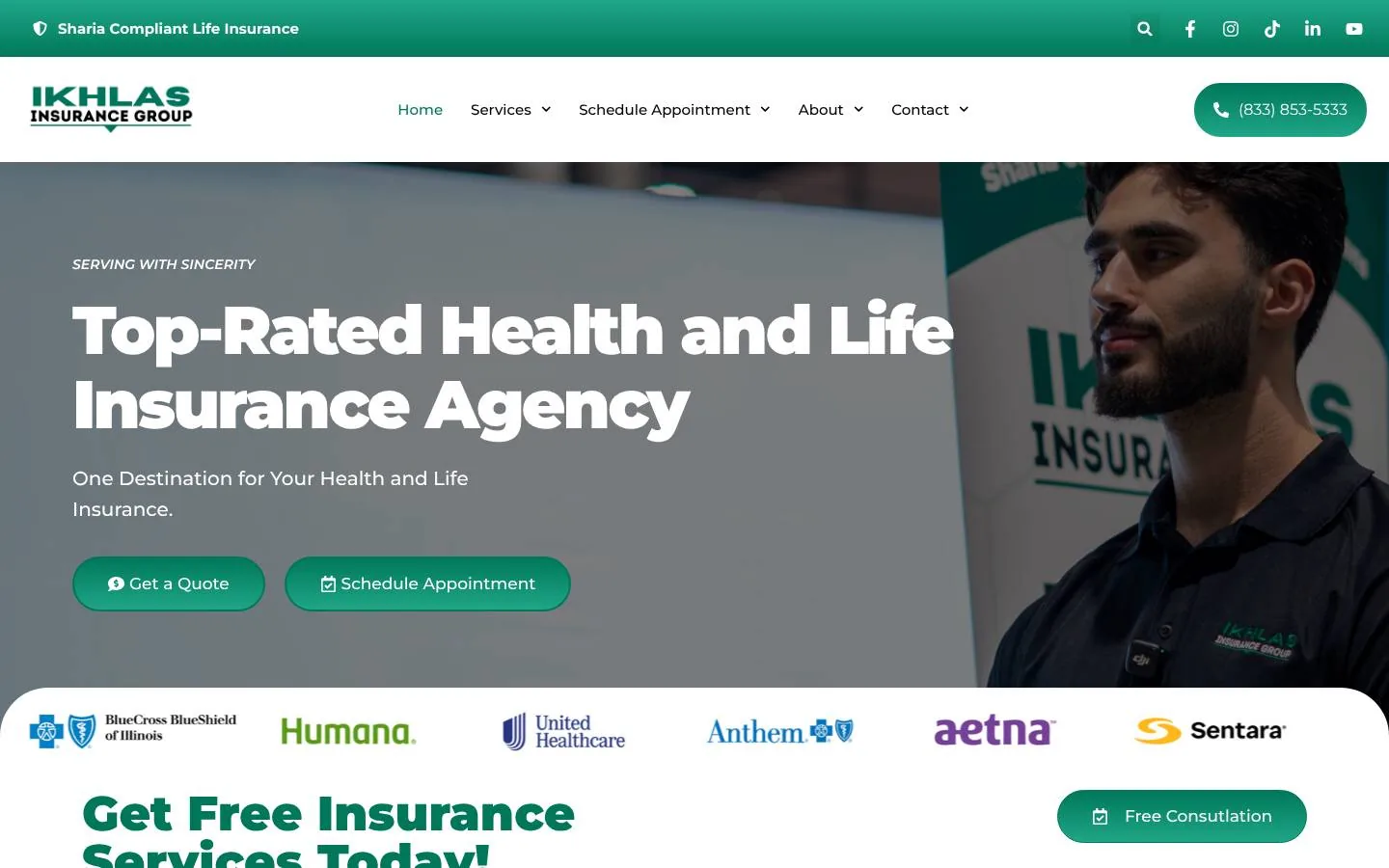
If you serve a specific community or language, say so clearly on your site and in your ads. See how we approached this in our Ikhlas Insurance Group case study.
Measure it: referrals and policies written per partner per quarter.
How to budget and measure your agency’s marketing
Budget from the value of a household, not a round number:
- Find your average annual commission per household and how many years households typically stay.
- Multiply them to get lifetime commission, then pick the share you are willing to spend to win one household.
- Track each lead to its source and outcome (quote, policy written) in your agency management system or CRM.
- Review monthly in season and quarterly the rest of the year, and move budget to the cheapest source of written policies.
Worked example (illustrative numbers, not a benchmark): if a household brings $600 a year in commission and stays seven years, lifetime commission is $4,200. Spending 15% of that to win a household gives a target of $630 per new household. If one in four quotes becomes a policy, you can spend up to about $157 to produce a quote. Use your own figures.
Get an insurance marketing plan built for the DMV
Pixel This Marketing is a Northern Virginia digital marketing agency with offices in Sterling and Ashburn. We build line-of-business pages, run search and Business Profile campaigns, and set up tracking that ties leads to written policies. Get a custom marketing proposal or book a call before your next enrollment season.
Frequently Asked Questions
What are the best marketing ideas for an insurance agency?
Plan campaigns around real enrollment and renewal dates, build a page for each line of business you write, keep a complete Google Business Profile, ask for reviews after helpful claims, email clients before renewals, and build referral partnerships with real estate agents, lenders and accountants.
When is open enrollment in Virginia and Maryland?
Virginia’s Insurance Marketplace lists open enrollment from November 1, 2026 through January 29, 2027. Maryland Health Connection lists Maryland open enrollment as November 1 to January 15. Confirm the dates on each official site before advertising them.
Can insurance agents use Google Local Services Ads in Virginia or Maryland?
Not currently. Google’s Local Services Ads list shows the insurance agency category for California and Florida only, so DMV agencies rely on Google Business Profile, SEO and standard Google Ads.
What disclaimer do Medicare agents need in their marketing?
Under 42 CFR 422.2267(e)(41), a third-party marketing organization that doesn’t sell every plan in the area must state “We do not offer every plan available in your area,” list how many organizations and plans it represents, and refer people to Medicare.gov or 1-800-MEDICARE.
Do Virginia insurance ads have to follow special rules?
Yes. Va. Code § 38.2-503 bans untrue, deceptive or misleading insurance advertising, and 14VAC5-90 adds rules for accident and sickness insurance ads, including genuine testimonials, naming the actual insurer and not looking like a government notice.
Last updated November 21, 2026